





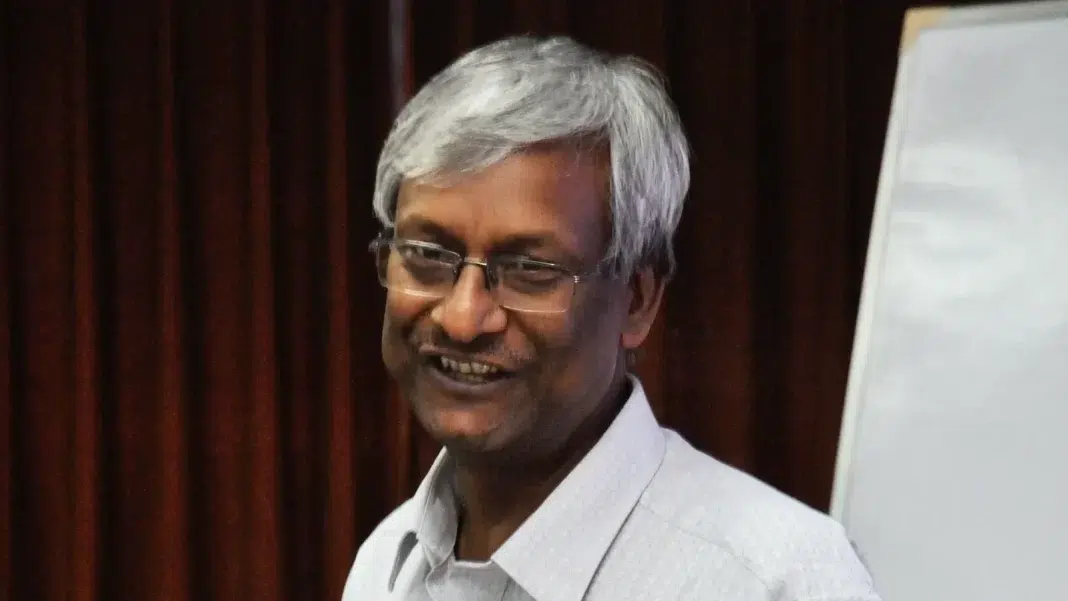

New Town, on Kolkata’s eastern edge, is a study in India’s urban ambitions. Wide boulevards cut through a landscape where technology parks, government offices and residential towers have risen from what were once wetlands and fishing ponds. In a utilitarian office building in Action Area 1A, on the fourth floor above the bustle of a rapidly expanding township, an unshowy company has spent nearly two decades building the technology that now watches a growing share of urban India.
If you have ridden through Bengaluru without a helmet recently, a camera somewhere noticed. If you have collected your luggage at one of more than eighty Indian airports, software has been making sense of you. If you have walked past a CCTV pole in Ahmedabad or Bhopal or Vijayawada, an algorithm has, in some sense, looked back. Much of that watching, that looking back, is now done with code written by a company called Videonetics, a name unfamiliar outside India’s security and surveillance trade, and a founder who has never, by his own account, applied for a job in his life.
That founder, Tinku Acharya, is in his early sixties, talks like a teacher because he used to be one and still travels on an Indian passport after thirty-six years in the United States. He is the principal inventor of Intel‘s first webcam, holder of more than 180 international patents and a Fellow of the IEEE. He could have stayed in Arizona indefinitely, perhaps growing wealthier and more decorated. Instead, in 2008, he came back. What he came back to do, the country is only now beginning to ask of itself.



Strategic question India is finally asking
In March 2024, the Union Cabinet approved the IndiaAI Mission, a programme with an initial outlay of about ₹10,372 crore, intended to underwrite the country’s bid for what policymakers have begun calling sovereign AI.
The phrase, fashionable from Brussels to Brasília, captures an anxiety that has crept into many capitals in recent years: that the foundational technologies of the next century, the models, the compute, the silicon, are being designed by a handful of mostly American and Chinese companies, and that nations without their own stack will not so much choose their futures as accept the futures chosen for them.
India is trying to answer that anxiety with money, datasets, GPU subsidies and, at last count, more than five hundred proposals to build indigenous foundation models. New centres of excellence in healthcare, agriculture, sustainable cities and education have been announced. Startups including Sarvam, Soket, Gnani and the IIT Bombay-led BharatGen consortium have been picked to build large language and multimodal models trained, in part, on Indian languages and Indian data.
By early 2026, the government was reportedly considering nearly doubling the mission’s outlay to about ₹20,000 crore over five years. Sovereign AI, in Delhi as in Paris, has become a strategic doctrine. Long before the doctrine had a name, Acharya had already focused on building indigenous video computing technologies in India.
Patient career
He was born in Howrah into a Bengali middle class for which a science degree is an inheritance and a passport. He took his bachelor’s, his B.Tech and his M.Tech in computer science at the University of Calcutta. He left, as so many of his generation did, for an American doctorate. His PhD, at the University of Central Florida in 1994, was in VLSI architectures for data compression: the unglamorous mathematics of making images small enough to travel down narrow pipes.
He did not, he likes to say, apply for any of the jobs that followed. The University of Maryland invited him on the strength of his publications. Bell Laboratories, the great cathedral of twentieth-century invention, asked him to come up to New Jersey. His Maryland mentor told him to go. At Bell Labs, his boss eventually told him to go to Intel.
In Acharya’s telling this is a parable as much about America as about him: of senior scientists who push their juniors out into bigger weather, who behave as mentors rather than as proprietors and who do not regard a talented colleague as an asset to be hoarded.
Intel, in the mid-1990s, was a company hunting for a future. Personal computers were becoming common. The internet was not yet ordinary. Cameras were still CCD-based and lived inside other appliances. Acharya, who had no formal training in image processing, was placed in a small research group working on CMOS sensors. He had to teach himself optics and image formation and the physics of light meeting silicon on the way to designing a chip that could do useful things with the pixels that came out.
The result, when he and his colleagues had finished, was the first webcam from Intel: a small, inexpensive camera meant to plug into a personal computer in an era when most personal computers could not yet process video, did not have USB ports and were not always online. Acharya was the architect. He says he understood at that moment, before broadband, before the iPhone, before TikTok, that the future of computing and communication would converge on video, and that video would become the consumer data of the twenty-first century.
He moved on to Intel’s reprographics processor, the MXP 5400 and 5800, the silicon that quietly transformed colour photocopying. Before that generation of chips, even expensive machines printed one or two colour pages a minute. After it, the world began to expect twenty-four. Every modern colour copier on a Xerox or Canon contract carries that genealogy.
By then he was in the top one per cent of Intel’s pay scale. For five consecutive years he was recognised internally as the company’s most prolific inventor, and twice as the most prolific inventor across all of Intel worldwide. He has four books to his name and patents granted in jurisdictions as varied as the United States, the United Kingdom, Canada, Singapore and Israel, the last of which is famously difficult to win over. He said he had, by any honest measure, made it. And then, with what he describes as the entrepreneur’s bug, he came home.
Patriot’s wager
Patriotism is a vague currency in the technology business. Many Indian-origin founders speak of contributing to India from California; relatively few sell the house and move. Acharya did. He calls himself a son of the soil and a patriotic scientist; whatever one makes of the phrases, he has lived them. He kept his Indian passport through his American career and in 2008 set up a small research outfit in Kolkata, gathered a few engineers around him and began work on what he calls, deliberately, a video computing platform.
The choice of words is not casual. Most of what is sold under the label of video analytics consists of bolting clever algorithms onto somebody else’s video management software, which in turn relies on somebody else’s operating system, on somebody else’s codecs, on a stack which, peeled apart, is owned in other countries.
Acharya’s wager was that this approach would not, in the long run, scale. To make sense of millions of camera feeds in a city like Hyderabad or an airport like Delhi, the entire stack, compute and storage and networking and codec and analytics and user interface, had to be designed together, by people who could see all the way down.
He spent the first decade in Kolkata not so much marching as plodding, building that platform in obscurity. Indian enterprises, he is candid about this, were not particularly interested. They preferred to license video management software from American and European vendors. Indian engineering colleges, year after year, produced master’s and PhD theses based on foreign research papers and foreign problems. The capital was elsewhere. The praise was elsewhere. The fashion was elsewhere. Then the smart cities programme arrived.
Indian cities are not Singapore
When Prime Minister Narendra Modi launched the Smart Cities Mission in 2015, the imagery was utopian: sensors, dashboards, intelligent traffic and responsive policing. The reality, as anyone who has ever sat in a Bengaluru jam can attest, was more textured. Indian cities are not Singapore.
They have monsoons, dust storms, power dips, two-stroke autos, processions, four-wheel pollution and an unbounded appetite for improvisation. Building a working surveillance platform here is not the same problem as building one for a Scandinavian capital, and most foreign vendors discover this only after they have been paid.
Videonetics turned out to suit the problem. Today the company claims deployments in roughly 150 Indian cities and more than eighty airports, including the entire states of Gujarat, Madhya Pradesh and Andhra Pradesh.
According to industry tracker Omdia, it has been India’s number one video management software vendor for seven consecutive years and one of the top ten in the Asia-Pacific region. Its platform integrates with more than 300,000 cameras. In Bengaluru, the city’s traffic enforcement, including the helmet-and-seat-belt regime that Acharya likes to cite, runs on its analytics. In Andhra Pradesh, statewide command-and-control dashboards lean on its face-matching and tracking.
This is not, on the face of it, glamorous work. It is also exactly the kind of work that countries discover they have outsourced only when something goes wrong. When a city’s eyes, its traffic monitoring, its public safety surveillance, its airport screening, are watched by software written abroad, the data trails, the model weights, the upgrade cycles and the support contracts pass through somebody else’s jurisdiction.
When the eyes are domestic, they are at least answerable to local courts and parliaments. The Indian government has begun, slowly, to articulate this as policy. Acharya said he has been building to it as architecture for nearly twenty years.
True AI and the panwala problem
Acharya, by training and temperament a teacher, is wary of the term AI itself. He uses it under protest. In the past two years, he points out, AI has been bolted onto everything from samosa stalls to ledger software. The panwala is now in machine learning. Many of the products carrying the label, he says, are doing nothing more sophisticated than what computer vision has done for two decades, dressed up for a hungry market.
To distinguish, Videonetics has begun to talk about True AI. The marketing language is unsubtle; the substance behind it is not trivial. About ten years ago, the company built its own deep learning framework, branded DeeperLook, on which it now trains its own object-detection and behaviour-recognition models.
It does not, Acharya says, rely on open-source models for inference; every video frame is analysed by code written and tested in-house. The platform is operating-system agnostic, written so that it does not depend on any particular Linux kernel or Microsoft product. Encryption sits all the way down at the operating-system layer. The codebase, by the company’s account, is free of GPL-licensed dependencies, an unusual claim in an industry built on open-source video libraries.
This obsession with owning every layer is not a quirk; it is the answer to a strategic problem. Hackers, Acharya likes to explain in a Socratic, lecture-hall mode, do not break encryption directly. They walk in through the network, climb into the server through the operating system, then read the data. If the operating system on which a country’s video analytics runs is a black box licensed from a foreign vendor, no amount of clever Indian code on top of it really protects the citizen whose face is in the database. He claims, with quiet pride, that no Videonetics deployment in those 150 cities and 80-plus airports has yet been breached.
Grey cases need humans
Asked what the biggest obstacle to AI-led surveillance in India really is, Acharya does not hesitate. The bureaucracy is great. The politicians are great. The corruption is great. The environment is great. The pollution is great. He says it without irony and with a teacher’s slight smile.
India, he means, is a hard country, and hardness is part of what makes the work meaningful. In such conditions, he argues, simply importing a foreign platform and switching it on does not work. Cameras placed in monsoon haze do not see what cameras placed in San Diego see. Number plates in twelve Indian scripts do not look like number plates in Phoenix.
The very assumption that everything can be automated, he says, is itself a foreign import and a dangerous one. He is at pains, throughout an hour-long interview, to insist that artificial intelligence is not a replacement for what he calls God-given natural intelligence. AI, in his view, can do things faster, at greater scale and with less fatigue. It cannot, on its own, decide the grey cases. The grey cases need human judgement, and the humans need training.
In Bengaluru, where Videonetics’ traffic enforcement system has been embedded for years, the company has built in checks and balances precisely because no visual computing system, however good, is ever a hundred per cent accurate. One per cent error, applied to a city of fourteen million, is still a great many wrongly issued challans.
Acharya spends much of his time, by his own account, educating police officers and bureaucrats not on how to use a dashboard but on what the technology can and cannot reasonably be asked to do.
This is, in some ways, the most striking thing he says, in an age when AI evangelists are competing to promise more. The man who built one of India’s largest indigenous video AI platform is at pains to tell you that humans must remain in the loop.
Privacy, cyber risk and the quantum horizon
On the question that civil liberties advocates worry that the same systems used for traffic enforcement can also expand state surveillance, Acharya says that question of privacy follows him into every conversation.
The Digital Personal Data Protection Act, India’s belated answer to Europe’s GDPR and California’s privacy regime, has begun, slowly, to be taken seriously as the enforcement date come closer. Surveillance platforms, by their nature, sit at the centre of the debate.
Acharya divides the problem into two parts: cybersecurity, the question of whether data can be stolen, and data privacy, the question of whether identities can be exposed even when nothing is stolen.
On the first, his answer is the platform architecture he has spent eighteen years building. On the second, he describes a set of GDPR-style features inside the platform: the ability to mask faces and number plates when footage is shared outside specific zones, granular access controls and audit trails. The company has, he says, taken those decisions into the product itself rather than leaving them as policy options that each city can quietly forget about.
He is also clear-eyed about what is coming. Quantum computing, when it arrives at meaningful scale, will tear through the encryption that secures most of today’s networks. Quantum-resistant cryptography will, at some point, become non-optional. He is personally working on quantum algorithms, he says, although without access to a real quantum machine the testing has to remain mathematical rather than experimental. The point of the example is broader: criminals innovate; the police must innovate faster; both are now joined by states with serious AI capabilities, and a society that cannot innovate will be permanently catching up.
Colonial mentality and the Indian enterprise
Where Acharya turns sharpest is on his own country’s institutions, and in particular its large private enterprises. India’s government, he allows, has begun to do its part. The Smart Cities Mission, the IndiaAI Mission, the centres of excellence, the language-aware foundation models are pieces of a coherent strategy. Indian private industry, however, in his telling, still prefers to license foreign technologies even when domestic alternatives exist and are demonstrably better.
He calls it a colonial mentality. The British ruled India for nearly two centuries; the habit of trusting the imported and discounting the local, he argues, has outlasted them. He is too disciplined to name companies, but he gestures at the multi-billion-dollar Indian enterprises that, on his account, prefer foreign video management software even when a certified, patented and battle-tested alternative sits on a desk in Kolkata. Charity, he says, should begin at home.
The other half of his complaint is structural. Year after year, hundreds of master’s and doctoral theses are written in Indian engineering colleges, almost all of them based on problems framed in American or European research papers. Why, he asks, are those theses not based on Indian problems, the ones that are actually unsolved, the ones whose solutions could power Indian companies? Why are Indian patents filed at a fraction of the rate of Chinese, American or Korean ones? Why do enterprises not pay for the indigenous research they ostensibly want?
His answer is that a culture of innovation has to be willed, not declared. Government can fund it; the press can celebrate it; but in the end, enterprises must adopt indigenous technologies, even imperfectly, even at the price of small early errors, if Indian invention is ever to compound. India, he says, cannot afford to be, in his memorable phrase, a nation of techno-coolies, doing services work for other people’s stacks.
Why a Bengali lab matters in the age of sovereign AI
There is a quietly Bengali quality to what Acharya has built, and not only because the headquarters sits in New Town. Kolkata, for all its decline in the league tables of Indian commerce, has remained one of the country’s deepest reservoirs of mathematics and physics. The Indian Statistical Institute trained generations of probabilists there. The IIT at Kharagpur, where Acharya has been a visiting professor, sits a couple of hours away. The city’s research culture has always been more comfortable with patient, paper-laden science than with the venture-capital sprint that defines Bengaluru and Gurugram.
Videonetics, which has produced more than two dozen patents and waited years for the market to mature, is plausibly the kind of company that could only have been started by someone willing to wait and most likely to be willing to wait in Kolkata.
That patience now meets a country in something of a hurry. India’s policy class has decided, more or less in unison, that the next decade will not be navigated successfully on borrowed AI. The IndiaAI Mission’s seven pillars cover compute, datasets, foundation models, skills, startup financing, safe AI and application development. The vocabulary of self-reliance, Aatmanirbhar Bharat, has migrated from defence procurement into software.
Government tenders increasingly favour indigenous platforms in critical sectors. Even India’s enterprise giants, however reluctantly, are beginning to ask of every foreign contract whether the same job could be done by an Indian team.
In that environment, a company like Videonetics begins to look less like an outlier and more like a template, says Acharya. It is not a unicorn. It is, however, the existence proof that an Indian deeptech firm, founded by a returning scientist, can build a globally credible platform in a sector dominated by American and Chinese competitors, and can earn the trust of its government in mission-critical deployments.
The man — Tinku Acharya
In person, on a video link from Kolkata, sipping his tea with the air of someone who would rather you also had a cup, Tinku Acharya is the sort of interlocutor for whom every question is a tutorial. He stops himself frequently, encourages the interviewer to interrupt, returns to first principles even when answering a casual aside.
His weariness with hype, particularly around AI, is not a pose especially when people are claiming to be selling AI samosas and pans. He says, with a half-smile, that some people seem to believe that pointing a camera at a coffee cup will eventually deliver them coffee.
The deeper push he says is not about a technology or company. It is about the kind of country India might choose to be over the coming decades. According to him, either it will continue to be the world’s back office, supplying skilled hands to other people’s invention, or it will become, slowly and unevenly, an originator: a place where the foundational technologies of the next era, in AI, in quantum, in semiconductors and in biotech, are not only adopted but designed.
Perhaps, the IndiaAI Mission represents the policy bet on the second path. People like Acharya are evidence that the first generation of that path can be walked.
He is, he says, an optimistic scientist. He believes the next generation, the one now in Indian engineering colleges, is more confident, more globally networked and less easily impressed by foreign labels than his own. He says that media coverage, of the slow, undramatic, patent-by-patent variety, can change which technologies enterprises trust.


