






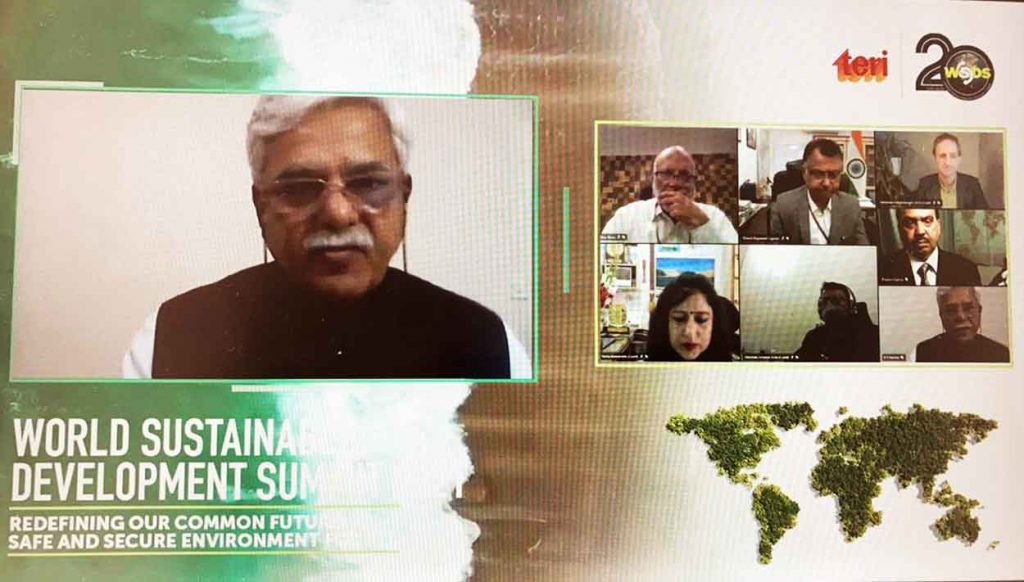
Prime Minister Narendra Modi calls for more fairness in the international struggle to limit global warming. “The road to fighting climate change is through climate justice, and this requires us to be large-hearted by thinking of the bigger and the long-term picture,” said PM Modi at the World Sustainable Development Summit (WSDS).
Modi asserted that changes in the environment and natural disasters impact the poor the most, and there is a need to give the developing country enough room to grow. “We are on track to exceed our commitments and targets”‘, he added with regard to the Paris Agreement. “We are committed to reducing the emissions intensity of GDP by 33 per cent to 35 per cent from 2005 levels. You will be happy to know that a drop of 24 per cent has already been achieved.”
The event being held from February 10-12 kick-started with an opening session on, “Harnessing the socio-economic co-benefits of renewable energy: Making the Paris Agreement a success for the planet of the people.”



The session discussed the outcomes of a recently published COBENEFITS India Policy report which was part of a three-year collaboration between TERI and the Institute of Advance and Sustainable Studies (IASS) based in Germany. It covers health, access to energy, and employment. According to the report, India can expect to see improvements in these three crucial areas if the government promotes renewable energies.
Hydrogen will be the key enabler of India’s electricity need
The other highlight of the summit was a panel discussion co-related to the opening session theme on co-benefits of renewable energy. The panel was chaired by R R Rashmi, fellow and programme director, TERI, and marked the presence of key experts from the industry.
Dinesh D Jagdale, joint secretary, Ministry of New and Renewable Energy, points out that it’s essential to put more focus on quantifying the co-benefits of renewable energy. The improvement in technology and declining cost have made renewable energy more penetrable.
Speaking about the country’s fuel cell initiative, Jagdale opines that, “Hydrogen will be the key enabler of India’s electricity need. It will play a big role in powering carbon-intensive industries such as steel, cement, fertilizer, and others.”
The study’s focus on employment in the renewable sector is highlighted by the chief executive officer of the Skill Council for Green Jobs, Dr Praveen Saxena. “We have developed 45 standards for all renewable energy job roles. To achieve the ambitious target of 450 GW, 18.5 lakh people would be working in the RE sector by 2030.”
High demand for skilled workers
He informs that the sector requires 75,000 people every year, which will be expanded to 100,000 every year. “A high emphasis is on skilling people ahead of time, even before the start of the project. The overall focus is to retain and upskill our already certified manpower in a standard manner,” states Dr Saxena.
Responsible for monitoring the United Nation’s Sustainable Development Goals (SDGs) on all dimensions, Dr Sekhar Bonu, director-general, Development Monitoring & Evaluation Office (DMEO), NITI Aayog, is of the view that some of the points that the COBENEFITS report mentioned are within the framework of outcomes.
However, there could be many causes of air pollution leading to health issues, so this is where further research is required. “It’s not just enough to just define the outcomes, but it’s also important to build robust data architecture to capture and measure them,” said Dr Bonu.
According to the report, India can markedly improve the livelihoods of its citizens by reducing ambient air pollution. In the
business-as-usual scenario, during 2050, almost 830,000 people will die prematurely due to exposure to particulate matter (PM10). By moving to the accelerated decarbonization pathway (NDC PLUS), more than 200,000 premature deaths can be avoided.
Finance Ministry calls for more commitment from developed countries
“There is a greater need for networking among all the stakeholders at various levels including central and state governments”, says Dr Nisha Mendiratta, advisor and scientist G, Department of Science and Technology.
A collaborative approach will help in meeting most of the SDGs. “We have established 25 climate change cells across the country and through them, we are trying to get climate-related information on district and sub-district levels,” Dr Mendiratta asserts.
Emphasizing on the challenges that the government is facing on mobilizing the resources for climate projects, Abhishek Acharya, joint director, Dept. of Economic Affairs, Ministry of Finance stated that the implementation of the Nationally Determined Contributions (NDCs) would also be contingent upon the resources that were received from the international community.
He especially calls for commitment from developed countries. “The international community has to come forward and has to reciprocate on providing the climate finances towards the developing country initiatives,” Acharya adds.
Sharing his thoughts on the importance of international collaboration for mobilizing further investment, Dr Sebastian Helgenberger, IASS COBENEFITS Project Director, explains that all countries can provide mutual inspiration on how things can work as they move forward on their pathway towards clean energy.
It’s also feasible in other democracies
“Through our projects across the world, we are trying to understand how renewable energy performs socially and economically in different countries,” says Helgenberger.
“The ambitious climate targets that the government of India has set and is on the way of achieving, give a clear indication to the rest of the world that if it’s possible in the biggest democracies on earth, then it’s also feasible in other democracies.”
Other dignitaries present at the inauguration of the event included Dr Mohamed Irfaan Ali, President of the Cooperative Republic of Guyana; James Marape, Prime Minister of Papua New Guinea, Mohamed Nasheed, Speaker of the People’s Majlis, Republic of Maldives, Amina J Mohammed, Deputy Secretary-General, United Nations, and Prakash Javadekar, Union Minister of Environment, Forest, and Climate Change (MoEF&CC).
Transparency note: The author of this article is also the co-author of the COBENEFITS POLICY REPORT


