






Key Points
- CCPA imposed ₹7 lakh penalty on Vajiram and Ravi for misleading UPSC advertisements
- Of 413 claimed successful candidates, 258 enrolled only in free Interview Guidance Programme
- Institute must stop such advertisements and comply within 15 days
NEW DELHI — The Central Consumer Protection Authority has imposed a ₹7 lakh penalty on Vajiram and Ravi IAS Study Centre for misleading advertisements linked to UPSC CSE 2023 results, holding that the UPSC coaching institute concealed important course details while using the names and photographs of successful candidates to promote its claims.
The order, passed on Friday (May 29) found that the institute’s advertisements and website claims could give prospective UPSC aspirants the impression that high-ranking candidates had taken its full-length courses when, in many cases, they had enrolled only in its Interview Guidance Programme after clearing the preliminary and mains stages of the Civil Services Examination.

The CCPA, headed by Chief Commissioner Nidhi Khare, with Commissioner Anupam Mishra on the coram, directed the institute to stop such advertisements, ensure future advertising complies with the Consumer Protection Act, 2019 and related guidelines and deposit the ₹7 lakh penalty within 15 days.
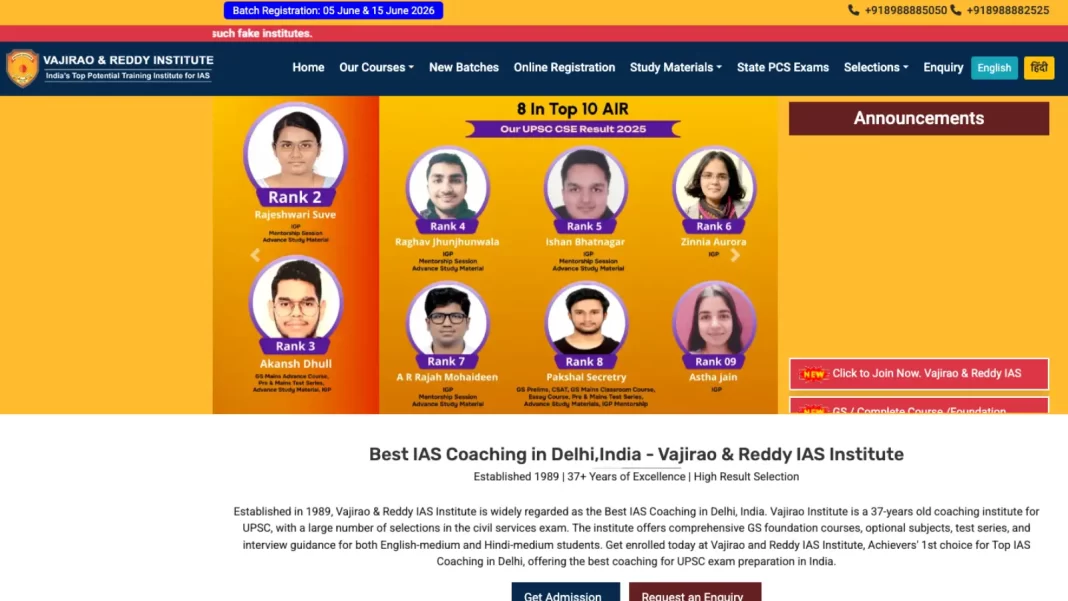
The proceedings arose from a suo motu case taken up by the authority after it examined the institute’s official website and found claims such as “8 Rank Holders in the Top 10 are from Vajiram & Ravi”, “Fact: Every year, more than 30% of the officers selected through UPSC Civil Services Examination are students of Vajiram & Ravi” and “37 Rank Holders in the Top 50 are from Vajiram & Ravi”.
CCPA says Vajiram & Ravi concealed UPSC course details
The CCPA’s central finding was not that the successful candidates had no association with the institute. Rather, it held that the nature of that association was material information for consumers and should have been disclosed clearly wherever the result-based claims were made.
The order said prospective UPSC candidates spend substantial time, effort and money while choosing coaching institutes. In such a market, advertisements using the names, ranks and photographs of toppers can strongly influence enrolment decisions. The authority said students were entitled to know whether a successful candidate had taken a full general studies programme, optional subject course, test series or only a short-term interview guidance module.
According to the order, out of 413 successful candidates claimed by the institute for UPSC CSE 2023, 258 had enrolled only in the Interview Guidance Programme. The CCPA said this programme comes after candidates have already cleared the preliminary and mains examinations on their own merit. The programme was also offered free of charge, meaning the institute did not issue fee receipts for those candidates.
Another 153 candidates had enrolled in other courses in addition to the Interview Guidance Programme, the order noted. The regulator said this pattern showed that a large part of the institute’s result-based claim rested on candidates who had reached the final interview stage before joining that programme.
The authority said that by not disclosing course-specific details alongside the claims, the advertisements could mislead consumers into believing that the successful candidates had received comprehensive coaching from the institute across the examination cycle.
The UPSC Civil Services Examination is conducted in three stages: Prelims, Mains and Interview. The order noted that marks from the Mains and Interview stages are considered for the final selection list. The CCPA said the Interview Guidance Programme was relevant to the final stage but could not be presented in a way that suggested the institute had contributed to the candidates’ success in the earlier stages unless that was factually supported and clearly disclosed.
The order also referred to available reports that about 13 lakh aspirants applied for UPSC CSE 2023, about 14,600 reached the Mains stage and 2,916 were called for the Personality Test. The regulator said that about one in every two candidates who appeared for the interview secured final selection. In that context, it said candidates who enrolled only in an interview guidance course had already independently cleared the more difficult preliminary and mains stages.
The CCPA said the omission of such information was not a minor detail. It described course type as “important information” because it directly affects how a prospective student evaluates the institute’s role in a candidate’s success.
The authority also rejected the argument that UPSC aspirants are highly educated and capable of seeking clarification before enrolling. It said the responsibility to make a truthful and non-misleading advertisement lies with the service provider, irrespective of the education level of the target audience. The order said consumer protection law has moved beyond the older doctrine of “caveat emptor”, or buyer beware, towards imposing clear obligations on sellers and service providers.
Vajiram & Ravi cited IGP data, no intent to mislead
During the proceedings, Vajiram & Ravi told the authority that it was an established coaching institute operating for about 48 years and offered courses for all three stages of the UPSC Civil Services Examination. It submitted that its courses were available in both online and offline modes.
The institute said all 413 successful candidates named in connection with UPSC CSE 2023 had been associated with it. It also argued that the list of successful candidates published on its website was a summary of its achievements and was not intended to be a detailed course enrolment brochure.
Vajiram & Ravi also submitted that its Interview Guidance Programme (IGP) was not merely a mock interview service. It said the programme included personality development classes, Detailed Application Form analysis, current affairs sessions, one-to-one sittings with directors, video analysis, mock interviews by retired bureaucrats and group discussions.
The institute told the authority that enrolment in the Interview Guidance Programme was done through a structured online process and that students received user IDs and passwords to access its services. It said the programme had about 1,200 to 1,500 students in a year.
It also said the disputed advertisement remained on its website for about 30 days and was removed after the CCPA’s notice. The institute argued that there was no material to show that it had gained an enrolment or financial advantage from the advertisement. It said the omission, if any, was inadvertent and not a deliberate attempt to mislead students.
The CCPA, however, was not persuaded by these submissions. It said course details may have been mentioned in newspaper advertisements but the matter before it concerned claims made on the institute’s website and other media. A website, the authority said, is continuously accessible and has a wider and more lasting impact than a newspaper advertisement that may be seen only for a day or two.
The order said the institute consciously chose not to disclose the relevant course details on its website, even though the website was the primary source through which aspirants would research coaching options. The authority said this omission could not be treated as accidental because the claim was displayed alongside names, photographs and ranks of successful candidates.
The CCPA also noted that several coaching institutes use names and photographs of the same successful candidates in advertisements without clearly explaining the course taken by those candidates. Such practices, it said, make it difficult for consumers to ascertain which institute a candidate had actually attended and what role the institute played in that candidate’s success.
The authority said non-disclosure of course type and duration creates confusion and can result in a false impression that successful candidates had been comprehensively trained by the institute across all stages of the examination. It held that this amounted to misleading advertising under Section 2(28) of the Consumer Protection Act, 2019.
The order also referred to the Guidelines for Prevention of Misleading Advertisements and Endorsements for Misleading Advertisements, 2022. It said advertisements must be truthful, honest and not mislead consumers by exaggerating achievements or hiding material facts.
In assessing penalty, the CCPA considered the nature of the claim, the potential impact on consumers, the size of the affected class and the conduct of the institute. It noted that the institute had physical centres in New Delhi and Chennai, provided online courses across the country, had about 6.5 lakh subscribers on its official YouTube channel and recorded large enrolment numbers across courses.
The authority said the impugned advertisement remained online for about 40 to 50 days after the result was declared and for about 15 to 20 days after the notice was received. It said the advertisement was accessible to lakhs of aspirants nationwide at a time when students were actively researching coaching options after the UPSC CSE 2023 result.
The order said that given the reach of the institute and the influence of result-based advertising in the coaching market, a penalty was necessary in the interest of consumers.
The case is part of a wider regulatory push against coaching centres that use toppers’ photographs and ranks without adequate disclosure of the course or programme taken by those candidates. The CCPA has in recent years scrutinised such advertisements amid concerns that aspirants and their families may be influenced by incomplete or exaggerated claims while making expensive coaching decisions.
The order makes clear that coaching institutes can use verifiable success data in advertisements, but must disclose material information in a prominent and transparent manner. For result-based claims, this would include the course opted by the successful candidate, whether it was paid or free, its duration and the stage of examination for which the course was taken.
For India’s highly competitive civil services coaching market, the decision signals that generic claims such as “our students” or “rank holders from our institute” may no longer be sufficient if they do not explain the actual nature of the candidate’s enrolment. The CCPA’s order places the burden on coaching institutes to ensure that aspirants are not left to infer facts that should have been disclosed upfront.
The institute has 15 days from the date of the order to deposit the ₹7 lakh penalty.
Your Questions, Answered
Why has the CCPA fined Vajiram and Ravi?
The CCPA found the coaching institute published misleading advertisements that used toppers' names and photographs without disclosing that most had enrolled only in a free Interview Guidance Programme after clearing Prelims and Mains independently.
How much is the penalty imposed on Vajiram and Ravi?
The CCPA has imposed a penalty of ₹7 lakh on Vajiram and Ravi IAS Study Centre. The institute must deposit this amount within 15 days of the 29 May 2026 order.
What did the CCPA find about Vajiram and Ravi's claimed toppers?
Of 413 successful candidates claimed by the institute for UPSC CSE 2023, 258 had enrolled only in the free Interview Guidance Programme, which is offered after candidates clear Prelims and Mains on their own.
What action must Vajiram and Ravi take following the CCPA order?
The institute must stop such advertisements immediately, ensure future advertising complies with the Consumer Protection Act 2019 and related guidelines, and pay the ₹7 lakh penalty within 15 days.


