





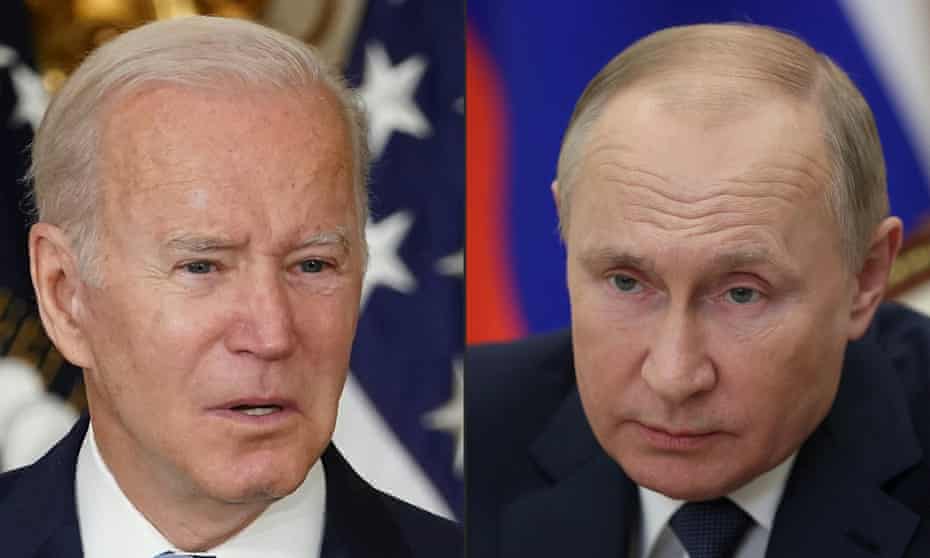

With the Russian army getting President Vladimir V Putin‘s clearance to march into two Russia-backed separatist territories in Ukraine, the White House has called the move an invasion.
The US President Joe Biden has also announced to slap tough economic sanctions as the country prepares to deploy sweeping financial penalties, not American troops, to hit Russia over President Vladimir Putin’s moves against Ukraine.
The Biden administration says its toughest sanctions package, already worked out in consultation with European allies, would be enough to hit Putin and Russia’s elites, cripple Russia’s ability to do business internationally, and likely bring on a recession there.




Following the Russian go-ahead to its troops into Ukraine, Germany announced that it would suspend its certification of the newly built but never operated Russia-to-Germany Nord Stream 2 pipeline.
A multibillion-dollar project of Russia’s Gazprom energy company and European companies, the pipeline would carry Russia’s natural gas to the lucrative markets of Europe.
The pipeline has been a top target of the Biden administration and Republican and Democratic lawmakers alike, who say the project was a strategic mistake from the start, increasing Putin’s political power over Europe by prolonging Europe’s dependence on Russia’s natural gas.
Reluctant to split with ally Germany, Biden has warded off repeated attempts in Congress to impose financial sanctions on any company or person that does business that involves Nord Stream 2, effectively making it financially impossible for the pipeline to operate.
It is, however, unclear if the US will still impose its own sanctions on Nord Stream 2, to amplify the actions that Germany just took. Biden made clear in recent weeks that Nord Stream had no chance if Russia invaded Ukraine.
Overall, the US and its allies aim to impose sanctions that compel Putin to change his ways, while minimizing the harshest impacts on ordinary Russians and any collateral economic damage on the US and European allies.
Sanctions are imposed on individuals listed on a Specially Designated Nationals and Blocked Persons List through the Treasury Department’s Office of Foreign Assets Control.
Also known as SDNs, the list includes individuals and companies owned or controlled by, or acting on behalf of a targeted country. Traditionally, their assets will be blocked and the US is almost completely prohibited from dealing with SDNs. Individuals, groups, companies and even aircraft can be given this designation.
Additionally, sectoral sanctions are an option to damage the economy. Sectoral sanctions apply to specific Russian firms – such as energy, finance, technology and defence – to be included on the Sectoral Sanctions Identifications List. Sectoral sanctions will limit some trade but will permit some transactions.
Specifically, new sanctions would likely hit Putin, his family and his circle – Republican lawmakers are itching to sanction the former Olympic gymnast that news reports have identified as Putin’s romantic partner – along with Russia’s privileged oligarchs.
Other potential targets would likely include Russia’s banks and financial system at large and Russia’s military leaders, military and their funding sources, among others.
Further for the US and its European allies, cutting Russia out of the SWIFT financial system, which shuffles money from bank to bank around the globe, would be one of the toughest financial steps they could take.
Allies on both sides of the Atlantic also considered the SWIFT option in 2014, when Russia invaded and annexed Ukraine’s Crimea and backed separatist forces in eastern Ukraine. Russia declared then that kicking it out of SWIFT would be equivalent to a declaration of war. The allies – criticized ever after for responding too weakly to Russia’s 2014 aggression – shelved the idea.
Russia since then has tried to develop its own financial transfer system, with limited success. The US has succeeded before in persuading the SWIFT system to kick out a country – Iran, over its nuclear program. But kicking Russia out of SWIFT would also hurt other economies, including those of the U.S. and key ally Germany.
Among other restrictions likely to hit the Russian economy hardest also include blocking Russia from access to the US dollar. Dollars still dominate in financial transactions around the world, with trillions of dollars in play daily.
Transactions in US dollars ultimately are cleared through the Federal Reserve or through US financial institutions. Crucially for Putin, that means foreign banks have to be able to access the U.S. financial system to settle dollar transactions.
The ability to block that access gives the United States the ability to inflict financial pain well beyond its borders. Previously, the US has suspended financial institutions from dollar clearing for allegedly violating sanctions against Iran, Sudan and other countries.
Further US export controls could cut off Russia from the high tech that helps warplanes and passenger jets fly and makes smartphones smart, along with the other software and advanced electronic gear that make the modern world run.


