





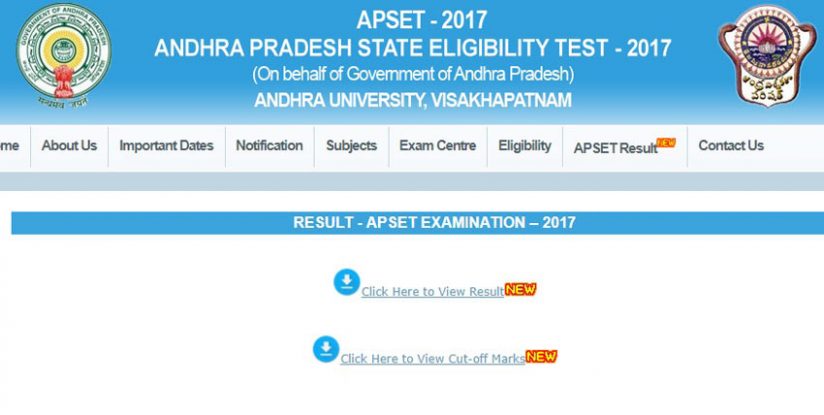

APSET 2017 results and APSET 2017 Cut Off marks have been released at the official website of APSET – apset.net.in. All the candidates who have appeared for this examination can now check their results. The cut off marks for all the subjects are between 48.57% (Telugu) to 64% (Geography). APSET 2017 examination was conducted by Andhra University, Visakhapatnam on behalf of Government of Andhra Pradesh on 30th July 2017 in 31 subjects approved by UGC New Delhi. The APSET is based on the guidelines provided by UGC. A total of 32282 candidates have appeared for the examination.
Out of total candidates, 6% of the appeared candidates who appear in all the three papers has been declared qualified for Eligibility for Assistant Professor /Lecturer. APSET 2017 results is available in pdf copy, so the student will have to search their results with roll number. The candidates whose roll number are in the list have provisionally been qualified through the Andhra Pradesh State Eligibility Test (APSET – 2017) for Assistant Professor/Lectureship held on 30th July, 201 7 subject to fulfillment of eligibility conditions. The results of APSET 2017 have been finalized as per the guidelines of UGC, New Delhi and these results were scrutinized and approved by the Moderation Committee and Steering Committee of APSET 2017.
As per Govt. of Andhra Pradesh reservation policy, the percentage allocation of reservations are: BC -A (7%), BC-B (10%), BC -C (1%), BC -D (7%), BC-E (4%), SC (15%), ST (6%). The 33.33% for Women category and 3% for PWD candidates are given reservation vertically in each category.





As per rule, the candidates have to secure at least 40% aggregate marks (all three papers put together) for candidates belonging to General category and at least 35% aggregate marks (all three papers put together) for candidates belonging to reserved categories are declared qualified for STEP-I stage for Eligibility for Assistant Professor/Lecturer. The calculation of slots for each subject and each category is based on ratio of number of candidates who secure minimum aggregate percentage of marks as prescribed in each subject and category-wise to the total number of candidates of that category over all subjects fulfilling minimum aggregate percentage multiplied by the total number of slots to be awarded to that category.
The nearest whole number obtained as per this formula provides the number of slots available in any particular subject category-wise. By this method if the number of slots obtained is less than one, it is taken as one, i.e. a minimum of one slot is awarded d wherever a fraction less than one is obtained as per the calculation. However for fractions greater than one, the figure is rounded off to the nearest whole number. The aggregate percentage of all the three papers corresponding to the number of slots derived as per the previous paragraph is taken as the cut off qualifying percentage marks for particular subject category-wise.
[embeddoc url=”https://apset.net.in/res_release.aspx” viewer=”google”]


