






Key Points
- Huawei Mate XT 2 debuts as world's first tri-fold phone with LogicFolding Tau chip
- Device starts at RMB 19,999 (approximately ₹2.80 lakh) with sales beginning 12 September in China
- Kirin 9050 Pro delivers 42 per cent performance improvement over predecessor
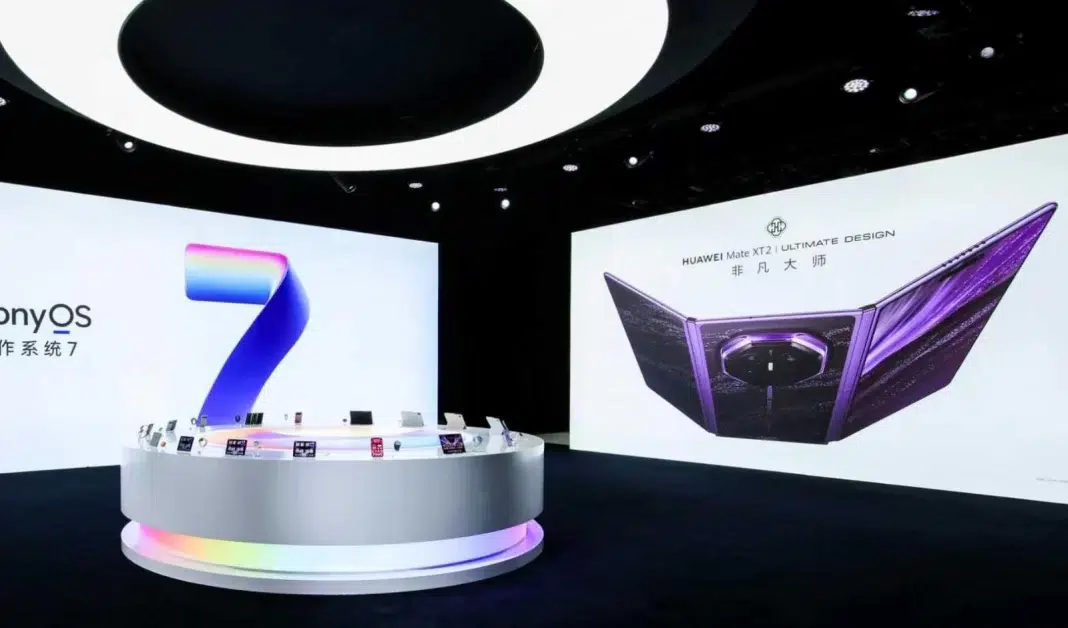
Huawei has launched the Mate XT 2 Ultimate Design, its second-generation tri-fold smartphone and the first device to feature LogicFolding Tau chip, marking the technology’s entry into mass production.
The Chinese technology company unveiled the device on Monday (7 September) in Guangzhou, positioning it as a significant upgrade over its predecessor with a new wing-like tri-fold design that opens from both sides.




The phone is powered by the Kirin 9050 Pro processor, which Huawei claims delivers a 42 per cent improvement in overall performance compared to the previous generation.
The Mate XT 2 will be available for purchase in China from 12 September, starting at RMB 19,999 (approximately ₹2.80 lakh). Huawei has not announced pricing or availability for markets outside China, including India, where the company’s smartphone business has faced challenges due to trade restrictions affecting its access to certain technologies.
Huawei Mate XT 2 Tri-fold design
The device introduces what Huawei calls the Xuanwu Ultra-Durable Tri-Fold Architecture, a redesigned hinge and screen system that the company says provides layered protection. The phone is the first tri-fold device to support IP58/59 dust and water resistance ratings, meaning it can withstand dust ingress and submersion in water under specified conditions.
The main display uses a multi-layer structure incorporating ultra-thin glass, known in the industry as UTG, along with aerospace-grade steel and a carbon fibre support layer. The cover screen features Kunlun Glass, Huawei’s proprietary strengthened glass technology, with anti-glare treatment for outdoor visibility.
By the numbers
Key figures from this story- RMB 19,999
- Starting price in China
- 42%
- Performance improvement over predecessor
- 12 September
- China sales date
The hinge mechanism uses a five curved arm structure with synchronised linkage, designed to distribute force evenly during folding and unfolding. This Advanced Precision Hinge System 2.0 builds on the architecture introduced in the original Mate XT.
The phone introduces an industry-first feature Huawei calls Smart Shield Privacy Screen, a hardware-level privacy protection system for foldable devices. The screen uses an independent dual-pixel design that maintains consistent resolution when privacy mode is activated. The system can automatically prompt users to enable privacy mode when entering locations such as airports or train stations.
Processing and connectivity
The Kirin 9050 Pro chip combines a CPU that Huawei calls LinxiCore with a Maleoon GPU featuring doubled computing units and cache compared to its predecessor. The graphics processor supports hardware-level ray tracing at 50 million rays per second, a rendering technique that simulates realistic lighting in games and applications.
The neural processing unit, or NPU, uses Huawei’s Da Vinci architecture and natively supports the Pangu 30B-A2B model. This is a mixture of experts large language model, a type of artificial intelligence system that activates different specialised sub-networks depending on the task, enabling on-device AI features through Huawei’s Celia assistant.
The device supports Tiantong satellite communication and Beidou satellite messaging, China’s domestic satellite systems, providing connectivity in areas without cellular coverage. The phone uses 32 distributed antennas for improved signal reception across multiple communication standards.
For thermal management, the tri-fold design distributes heat-generating components across three frames, working with vapour chambers and graphene materials to conduct heat away from processors. The device includes a mobile security processor with post-quantum cryptography support and has achieved EAL5+ security certification from China’s CCRC.
The camera system features True-to-Colour Camera 3.0, which the company claims improves colour reproduction by 95 per cent through better infrared light filtering. The array includes an ultra-HDR main sensor, a periscope telephoto lens and an ultra-wide angle camera. Video recording supports an 18 EV dynamic range, a measure of the camera’s ability to capture detail in both bright and dark areas of a scene.
The device runs HarmonyOS 7, Huawei’s proprietary operating system, with features optimised for the large foldable display including three-window parallel multitasking with independent volume control for each window.
Your Questions, Answered
What is the price of the Huawei Mate XT 2?
The Huawei Mate XT 2 Ultimate Design starts at RMB 19,999 in China. The company has not announced pricing for international markets including India.
When will the Huawei Mate XT 2 be available?
Sales begin on 12 September in China. Huawei has not announced availability dates for other markets.
What processor does the Huawei Mate XT 2 use?
The device is powered by the Kirin 9050 Pro chip, which Huawei claims delivers 42 per cent better performance than the previous generation.
Does the Huawei Mate XT 2 support satellite communication?
Yes, the device supports Tiantong satellite communication and Beidou satellite messaging, China's domestic satellite systems for connectivity without cellular coverage.


