







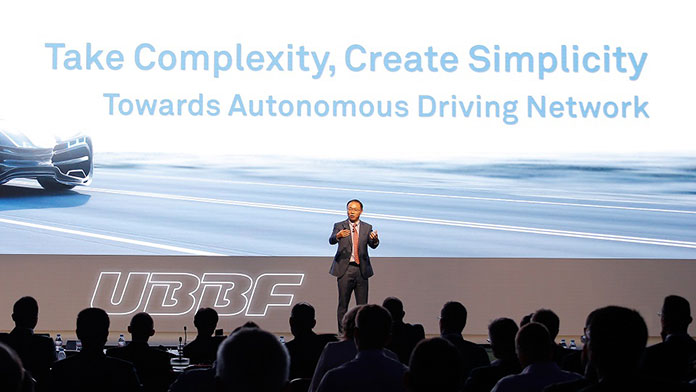
The telecom sector is facing a major structural problem as networks are growing but OPEX is growing faster than revenue, said a senior Huawei’s executive during the fifth Ultra-Broadband Forum (UBBF 2018). David Wang, Huawei’s Executive Director of the Board and President of Products & Solutions said “It takes 100 times more effort for telecom operators to maintain their networks than OTT players. Therefore, it’s imperative that telecom operators build autonomous driving networks.”
Humanity has never stopped in its pursuit of higher productivity. In 1947, US completed the first autonomous transatlantic flight. 1983 witnessed the world’s first driverless metro – Métro de Lille – going live in France. In 2012, Google obtained the world’s first self-driving car license in Nevada, with its self-driving cars traveling 8 million kilometers as of March 2018. Every change seen throughout the industries is driving society towards a new era.
Unlike autonomous cars, the telecom industry faces unique complexities. In terms of service diversity, a telecom network provides multiple services such as mobile, home broadband, and enterprise services. Therefore, an autonomous driving system must accurately understand the intent behind different services. As for the operating environment and road conditions, there are highways that act like data centers and urban and rural roads that provide broadband access to citizens. Therefore, autonomous driving systems must be able to adapt to complex environments that involve multiple technologies. From the perspective of full lifecycle operations, different roles, such as planning, O&M, and service provisioning, face different challenges.



Wang asserted, “In a fully connected and intelligent era, autonomous driving is becoming a reality. Industries like automotive, aerospace, and manufacturing are modernizing and renewing themselves by introducing autonomous technologies.”
Wang said, “Evolution towards autonomous driving networks must be advanced by scenario and follow three key principles: First, we should focus on major issues related to OPEX. Second, we need to start from a single domain to multiple domains, from a single task to multitasking, and then form a closed-loop system. Third, we must develop experience-driven and top-down data models and sharing capabilities.”
Autonomous driving networks go far beyond the innovation of a single product and are more about innovating system architecture and business models. Huawei calls for all industry players to work together to clearly define standards and guide technological innovation and rollout. Based on service experience and operating efficiency, Huawei has proposed five levels of autonomous driving networks for the telecom industry.
“On the journey to autonomous driving, telecom networks are facing numerous challenges, including the invisibility in network status and the separation of operation and maintenance systems,” said Wang. “This requires us to systematically reshape and innovate the network architecture and key technologies. In particular, first, we need to build an edge intelligence layer on physical networks to sense network status in real-time and simplify network architecture and protocols. Second, we will use unified modeling to build digital twin networks and make network status traceable and predictable. AI can also be introduced here to enable predictive O&M and active closed-loop optimization. Third, an open cloud platform is needed to support AI algorithm training and optimization, and the agile development of applications such as planning, design, service provisioning, O&M guarantee, and network optimization. The aim is to automate closed-loop network operations throughout the entire lifecycle.”
“It’s a long journey towards autonomous driving networks. To make our dream a reality, the industry must work together and forge ahead,” he added.


