





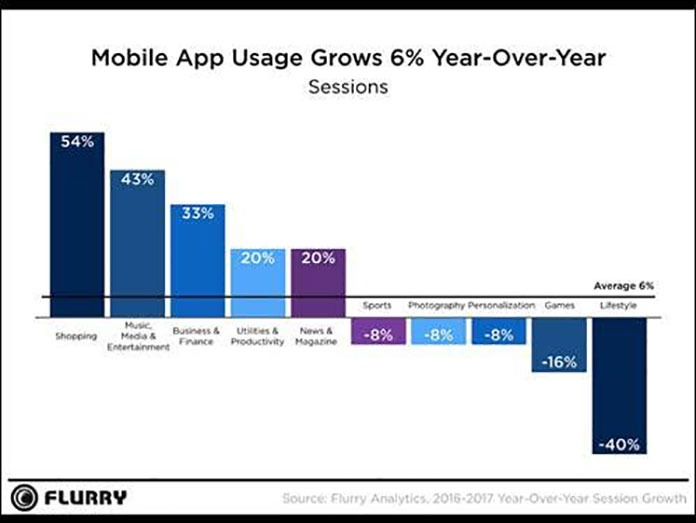

Flurry Analytics, part of the Yahoo Mobile Developer Suite announced its annual global mobile and application usage study. Compared to 2016, Flurry measured overall session app activity growth of just 6%. While growth may have stagnated, users continue to diversify their behaviour while using mobile applications, said Yahoo. Flurry’s app footprint track more than one million applications, across 2.6 billion devices globally.
This past year’s 6% growth is down from 11% in 2016. As we reported last year, users now spend more than five hours a day on their smartphones, and shift their daily time spent between new and old app experiences, versus giving more of their overall daily time.
The Shopping category grew by 54% as consumers continue to shift their spending into e-commerce via mobile shopping apps. Users are increasingly comfortable making physical purchases on their phones with now ingrained in-app digital purchase habits. Additionally, digital wallet services such as Apple Pay and Samsung Pay allow seamless access to stored payment information for mobile purchases. Music, Media, and Entertainment came in a close second with 43% year-over-year growth, reaffirming users’ shift to mobile devices to consume media.



Lifestyle saw the steepest decline in growth with -40% in 2017. The decline in Lifestyle, a catchall category for both the Google Play and Apple App stores, highlights an app’s need to build daily usage habits in order to retain or increase year-over-year growth. While Gaming saw another year of decline in sessions with -15% in 2017, Flurry has previously reported that gamers are spending more time and money in mobile games than ever before.
Understanding form factor adoption is critical for both app developers and marketers, as we know that usage differs between devices. 2017 proved that there is no end in sight for phablet growth – they represent a staggering 55% of active devices. As medium phone users trade in their devices, it is clear that they’re opting for phablet devices, as 9% of the phablet growth came from medium phone adoption decline.
Although Android manufacturers make up two thirds of all active devices in 2017, Apple dominates individual market share with 34% of all active devices. Samsung maintained their share between 2016 and 2017 with 28% and will look to return to growth in 2018 with the launch of the S9. Chinese manufacturers Huawei, Xiaomi, and OPPO round out the top five and are slowly seeing growth by driving adoption in Asia Pacific and European markets.
Although session growth may have stalled, it has never been more apparent that mobile apps and smartphones have cemented their roles in users’ lives. While users, marketers and the tech industry drive towards what’s next, developers have an incredibly captive audience and a platform to engage them.


