





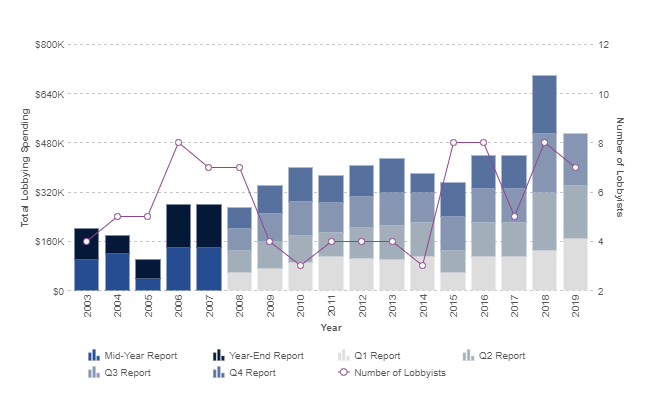
National Association of Software and Services Companies (Nasscom), India’s IT services trade group, spent $510,000, or about Rs 3.4 crore, in 2019 to lobby with the US government, making it the third biggest tech lobbyist in US.
The amount spent on lobbying on immigration and advocacy in 2019 was less compared to $700,000 poured in the year before. Prime focus of Nasscom included the department of commerce, education, department of homeland security, and department of labour.
As per as per data from the website opensecrets.org, which tracks political contributions in the US, Microsoft topped the list with $7.8 million on lobbying efforts, followed by Cognizant, which spent $1.7 million. The website is run by the non-partisan and non-profit Centre for Responsive Politics.



Overall, Nasscom spent $270,000 with Republic Consulting, a bipartisan boutique of both Democratic and Republican Consultants. It spent $150,000 with the Lande Group. Immigration trade, education and foreign relations were some of the top issues on its list.
In 2019, Nasscom hired Spencer Abraham, the former Republican senator from Michigan and US energy secretary under former president George Bush, as lobbyist to communicate to the Trump administration about how the $170-billion Indian IT industry has serviced a majority of the Fortune 500 in their transformation programmes.
Until some months ago, John Engler, the Michigan governor in the Bush regime, was one of Nasscom’s advisers on public policy. Nasscom had hired Engler to communicate how the US would benefit from a continuation of the current H-1B visa programme.
Way back in 2003, India began using the services of US lobby firm to reach out to senators in the US Congress, when US government began applying restrictions on the H-1B visa programme in view of mounting pressure from worker associations, whose jobs were being affected by American companies outsourcing jobs to foreign countries including India.
Since then, Nasscom has spent significant sums of money every year on lobbying the case for Indian technology companies with the US government. While there have been several Bills proposed to curb H-1B visas, there have been none that have been converted into law.
Nasscom’s expenditure on lobbying over the years in US
| Year | Amount (US dollar) |
| 2003 | 200,000 |
| 2004 | 180,000 |
| 2005 | 100,000 |
| 2006 | 280,000 |
| 2007 | 280,000 |
| 2008 | 270,000 |
| 2009 | 340,000 |
| 2010 | 400,000 |
| 2011 | 375,000 |
| 2012 | 405,000 |
| 2013 | 430,000 |
| 2014 | 380,000 |
| 2015 | 350,000 |
| 2016 | 440,000 |
| 2017 | 440,000 |
| 2018 | 700,000 |
| 2019 | 510,000 |


