






Key Points
- Stokel-Walker traces AI from Turing to ChatGPT without treating it as a sudden miracle
- Book warns society cannot repeat the regulatory mistake made with social media
- Environmental costs of AI including data centres and energy use receive dedicated treatment
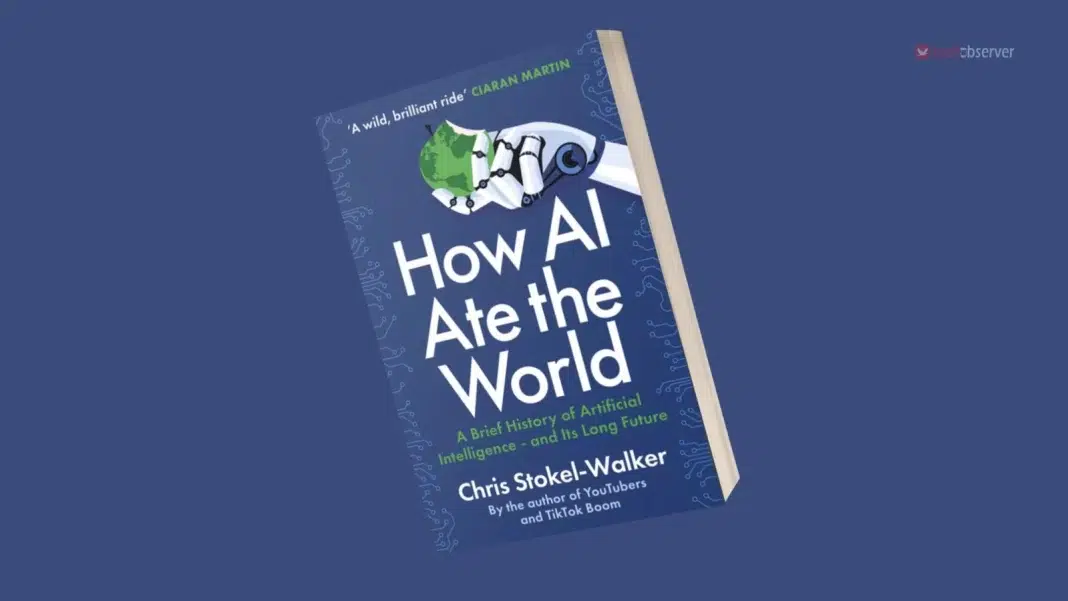
As books seeking to explain artificial intelligence occupy more space on shelves and in public debate, Chris Stokel-Walker’s How AI Ate The World: A Brief History of Artificial Intelligence and Its Long Future has one clear advantage—it does not treat AI as a miracle that began with ChatGPT. It places the current generative AI boom inside a longer, messier history of ambition, disappointment, capital, labour, cultural theft, scientific ingenuity and regulatory failure. The result is a lively, accessible and often unsettling account of how AI moved from laboratory dream to mass-market force.
The book opens with a simple provocation. Stokel-Walker begins with a passage written by ChatGPT, then quickly reveals the trick. It is an effective device because it makes the reader confront the central problem of the AI age: the output can look competent, fluent and structured, yet still lack the intelligence, judgement and accountability that come from human authorship.


This opening also establishes the book’s method. Stokel-Walker is not interested in treating AI as abstract machinery alone. He is interested in the humans behind it, the humans affected by it and the systems that allow the technology to scale before society has understood the consequences.
The strongest sections of the book are those in which history and anecdote work together. The opening chapter on the viral image of Pope Francis in a puffer jacket is a good example. The episode could have been treated as a familiar warning about deepfakes. Instead, Stokel-Walker uses it to show the unstable chain that links individual experimentation, platform dynamics, public credulity and media amplification.
A private act of play becomes a global confusion event. The point is not simply that AI can make fake images. The point is that AI-generated media enters an information ecosystem already trained to reward speed, outrage and novelty.
From there, the book moves backwards to Alan Turing, John McCarthy, Marvin Minsky, Claude Shannon, Frank Rosenblatt and the Dartmouth conference. This historical stretch is necessary because it corrects one of the lazier myths around AI that the technology appeared suddenly because Silicon Valley finally found the right business model.
Stokel-Walker shows that AI has always been shaped by rivalry between competing schools of thought, especially symbolic AI and neural networks. He is particularly good at showing how scientific progress is uneven. AI advances, stalls, loses funding, returns under a new name and then gets absorbed into another wave of hype.
A History Before ChatGPT
The early history also benefits from Stokel-Walker’s journalist’s instinct for character. Turing is presented not merely as a famous name attached to a test, but as an outsider whose theoretical imagination ran ahead of the hardware available to him. McCarthy’s role in naming and organising the field is handled with similar clarity.
The book does not overburden the general reader with mathematics, but it gives enough context to show why terms such as perceptron, neural network, transformer and large language model matter. For a non-specialist reader, this is one of the book’s practical strengths.
The narrative becomes more urgent when it reaches the modern AI economy. Stokel-Walker traces the rise of OpenAI, the importance of the transformer model, Microsoft’s role, AI chips and the competitive forces that turned research into a commercial arms race.
These chapters are valuable because they connect technological progress with institutional incentives. AI is not presented as a neutral tool drifting into society. It is being pushed by companies with investors, cloud infrastructure, data needs, reputational pressures and strategic dependence on scale.
The book is also at its best when it discusses the creative industries. Stokel-Walker treats AI art, music, books and film not as side issues, but as central battlegrounds over authorship and value. The chapters on Midjourney, prompt engineers and copyright disputes capture a moment in which artists, writers, performers and publishers are being forced to defend basic claims over labour and originality.
The book does not romanticise every objection from creative workers. It recognises that tools change industries. Yet it is clear-eyed about the asymmetry between individual creators and companies that can scrape, ingest and monetise years of human work.
That concern runs through the book’s treatment of labour. Stokel-Walker avoids the simplistic binary that AI will either destroy all jobs or free everyone from drudgery. Instead, he shows a more plausible and more troubling reality that AI changes tasks before it changes professions.
It can devalue certain kinds of work, intensify surveillance, produce new forms of outsourced digital labour and concentrate economic gains among those who own the infrastructure. This is a useful corrective to the executive-class language that often presents AI adoption as inevitable efficiency.
The chapters on misinformation and disinformation are among the book’s most relevant for India and other large democracies. The author recognises that AI-generated falsehood does not need to be perfect to be dangerous. It only needs to be cheap, scalable and plausible enough to pollute public conversation. The book’s discussion of synthetic media, election risk and automated persuasion feels especially important in societies where political communication already travels at high velocity through messaging platforms and short-video networks.
The environmental chapter is another necessary intervention. Public discussion of AI often focuses on intelligence, productivity and disruption. Stokel-Walker brings attention back to material costs such as data centres, chips, energy, water and carbon. This is one of the book’s quieter strengths. It reminds the reader that the cloud is not weightless. AI may feel frictionless on a phone screen, but it sits on an industrial stack with measurable consequences.
The book’s limitations arise partly from the speed of the subject it covers. AI is moving so quickly that any account published in 2024 risks ageing almost immediately, and that shows in places. One notable omission is Anthropic’s Claude, which receives little to no attention despite becoming one of the most discussed AI models and companies among consumers, enterprises and government organisations globally. This does not weaken the book’s broader historical argument, but it does underline the difficulty of writing a definitive account of a technology still changing in real time.
However, Stokel-Walker partly try to balance this by writing a history of structures, not just events. Still, some parts of the book feel closer to a dispatch from a fast-moving news cycle than a settled interpretation. The OpenAI board crisis, regulatory responses and sovereign AI debate are handled well, but these are still unfolding stories. Future readers may treat those chapters as a snapshot rather than a final account.
Gaps in a Fast-Moving Story
There is also a slight overcrowding problem. Because the book tries to cover history, technology, culture, labour, copyright, regulation, bias, loneliness, disinformation, big tech and sovereign AI, some themes move faster than they deserve. The sections on coded bias and global inequality could have carried more weight if they had been given more room.
The Global South appears in the book’s later argument around sovereign AI and language datasets, but there is scope for a deeper treatment of countries such as India, where linguistic diversity, state capacity, data governance and digital public infrastructure make the AI question far more complex than in the US or UK.
Still, these weaknesses do not undermine the book’s central achievement. How AI Ate The World succeeds because it refuses two easy positions. It does not write AI off as a gimmick. It also does not surrender to the belief that every new capability must be accepted because it is technically possible. Stokel-Walker’s argument is more grounded—AI is powerful, uneven, extractive, useful, dangerous and still deeply shaped by human choices.
The prose is brisk without becoming shallow. Stokel-Walker writes with the pace of a reporter, which helps the book move through technical and policy-heavy material without becoming dense. The trade-off is that readers looking for deep computer science or a rigorous philosophical account of machine intelligence may find the book introductory. But that is not a major flaw. Its value lies in synthesis. It gathers the scattered debates around AI and turns them into a readable public narrative.
The final argument is blunt: society cannot repeat the mistake it made with social media. For two decades, governments allowed platform companies to scale first and answer questions later. AI demands earlier scrutiny because its reach will be wider. It will sit inside customer service, healthcare, education, policing, immigration, media, law and personal life. The book’s closing warning is persuasive because it is not built on science-fiction apocalypse. It is built on the more immediate risks of bias, concentration of power, environmental strain, labour displacement and democratic distortion.
How AI Ate The World is not the definitive book on artificial intelligence. No book published at this stage can be. It is better understood as a clear, timely and sceptical map of the forces that brought AI to its current moment. Its strength is not prediction. Its strength is explanation. Stokel-Walker shows that AI did not simply arrive. It was built, funded, hyped, resisted, normalised and unleashed. That makes the book worth reading not because it tells us exactly where AI is going, but because it helps explain why the world was so unprepared when it got here.
- Title: How AI Ate The World: A Brief History of Artificial Intelligence and Its Long Future
- ISBN: 978-93-92279-11-9
- Author: Chris Stokel-Walker
- Publisher: The Bombay Circle Press
- Pages: 306
- Price in India: ₹499.00 (Paperback)
- Availability: Online and Offline
Your Questions, Answered
What is How AI Ate The World about?
Chris Stokel-Walker's book traces the history of artificial intelligence from Alan Turing and the Dartmouth conference to the ChatGPT era. It covers the commercial forces driving AI, the impact on creative industries and labour, misinformation risks and environmental costs.
Is the book suitable for readers without technical background?
Yes. Stokel-Walker writes with a journalist's pace and explains terms such as neural network, transformer and large language model without requiring mathematics. Readers seeking deep computer science may find it introductory.
Does the book cover AI's impact on India?
The book discusses misinformation risks relevant to large democracies including India and mentions sovereign AI and language datasets. However, the treatment of India-specific issues such as linguistic diversity and digital public infrastructure is limited.
What is the book's main argument about AI regulation?
Stokel-Walker argues that society cannot repeat the mistake made with social media, where platforms were allowed to scale before facing scrutiny. AI demands earlier regulation because its reach will extend into healthcare, education, policing and daily life.


