






My journey is personal, but it is also profoundly national. I grew up from a small village in Jharkhand, where barriers are not theoretical concepts, they were lived realities. Distance from opportunity. Scarcity of quality education. Fragile connectivity. And often, silence instead of voice.
Growing up in rural India teaches you an early lesson: progress that excludes people is not progress at all. That lived truth has shaped my lifelong belief that digital growth must not erode dignity, innovation must remain grounded in Indian civilisational values, and artificial intelligence must narrow inequality not widen it.
Yet, that very soil also produces resilience, aspiration, and clarity of purpose. From this contrast emerges a governance vision that is neither abstract nor elitist but deeply inclusive.

The Sovereignty Pyramid: The Architecture of a Viksit Bharat
At the heart of my philosophy lies what I call the Sovereignty Pyramid – a framework to ensure that development is owned, trusted, resilient and equitable.
- Chip Sovereignty: The Physical Bedrock
Indigenous semiconductors, affordable devices and resilient hardware ecosystems are not just industrial priorities but they are instruments of social inclusion.
For a rural child, access to a device is access to the future. Reducing dependence while increasing resilience is the first step towards national self-belief.
- Cloud Sovereignty: The Digital Commons
A trusted, interoperable national cloud ensures that data remains governed by national interest while enabling scale for governance, healthcare, education and welfare. When cloud infrastructure becomes sovereign, geography stops deciding destiny – whether in mountains, forests, islands or border villages.
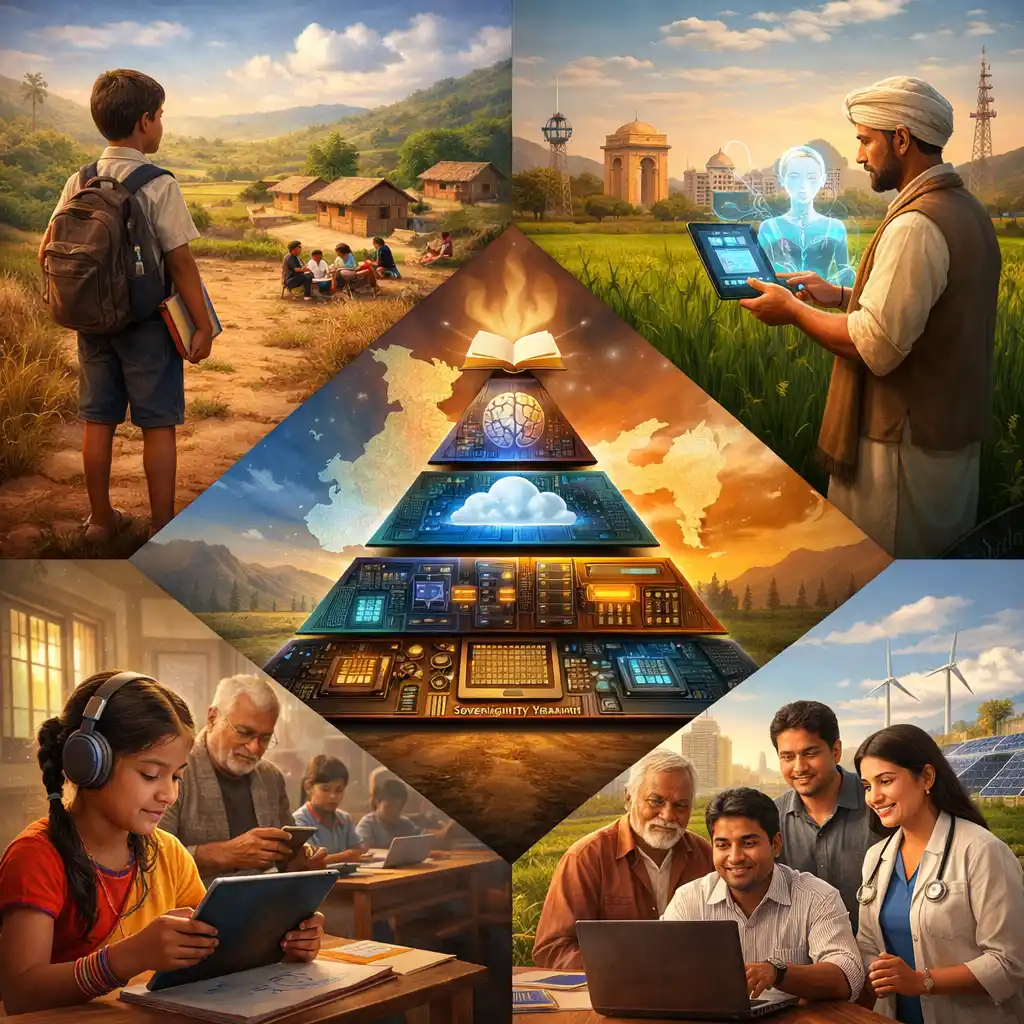
- AI Sovereignty: Intelligence with Indian Values
AI must be trained on Indian languages, datasets and realities. It must be bias-aware, explainable and citizen-centric. AI should augment governance not replace human judgment. When done right, age, caste, gender, income or location cease to be disadvantages.
- Knowledge Sovereignty: The Apex
True development peaks when knowledge flows freely and contextually. Skill must matter more than pedigree. Capability more than privilege. Learning must be continuous and embedded into governance itself—so that knowledge reaches the citizen, not the other way around.
From Old Bharat to Viksit Bharat
This transformation is not incremental, it is structural.
| Barrier | Old Bharat | Viksit Bharat |
| Demographic | Youth vs Elderly | AI-enabled services for every age |
| Geographic | Urban-first | Cloud-first, village-aligned |
| Education | Degree-centric | Skill & knowledge-centric |
| Literacy | Text-heavy | Voice, visual, vernacular AI |
| Economy | Subsidy-driven | Capability & opportunity-driven |
We must not aim for a welfare governance rather we aim for an empowerment governance. A Viksit Bharat is where technology listens before it acts, growth respects both people and planet and AI becomes a companion in development and not a controller.
Governance Reimagined: Citizen at the Center
The future governance model is simple yet transformative. A farmer consults AI in his own language. A tribal student accesses world-class education. A migrant worker carries identity, skills and entitlements seamlessly across states. For a larger good, ‘The citizen is the platform, the state is the enabler and technology is the silent equaliser.’ Sovereignty in true sense must be felt, not merely framed.
Human-Centric and Sustainable Technology: The Soul of Development
A developed nation is not defined by how advanced its technology is but by how human it remains. AI must serve the last citizen, not just the first mover. That means:
- Voice-first and visual-first interfaces
- AI that works in low-bandwidth or offline conditions
- Systems designed for inclusion before sophistication
- Technology that understands context, not just data
- AI that empowers frontline workers, not sidelines them
In a true Viksit Bharat, a villager is empowered not overruled. A citizen is assisted not surveilled. Empathy must be embedded into code.
AI That Augments Humans, Not Replaces Them
In governance:
- AI enhances human judgment
- Humans remain accountable decision-makers
- Algorithms are transparent, explainable, and contestable
For us, trust is not optional, it is foundational.
Sustainable by Design, Not by Afterthought
Technology growth and sustainability must advance together where energy-efficient chips lower carbon footprints, green cloud infrastructure optimises compute and resources, purpose-driven AI strengthens climate action, agriculture, health and education and digital-first governance reduces paper, travel, and waste. In essence, technology must become an enabler of climate responsibility, not a burden.
The Arc of the Journey
My personal arc mirrors the national one – from scarcity to strategy, from exclusion to ecosystem, from village pathways to national policy. I have witnessed a vision that resonates only when it is authentic, earned and future-facing.
One-Line Manifesto
“A Viksit Bharat is not built by importing intelligence, but by sovereignly empowering every Indian to participate, contribute and prosper. True sovereignty lies in building technology that is intelligent enough to scale, wise enough to sustain and humane enough to serve every Indian.”
The author is President of Technology and Innovation at BLS International. He previously served as Chief Technology Officer, Passport Seva Programme at the Ministry of External Affairs. Views are personal.


