





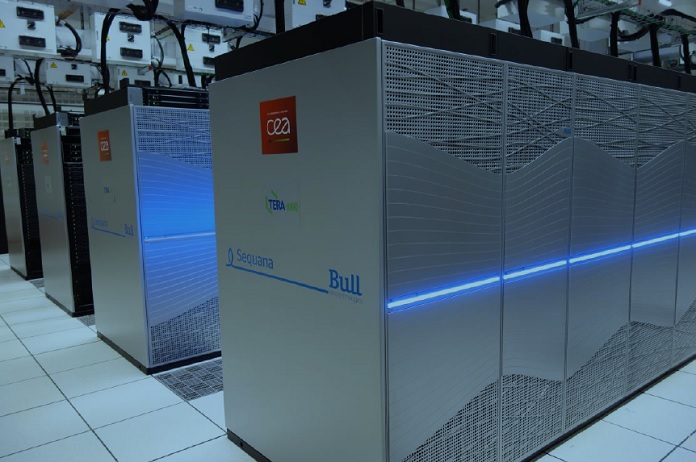

The Tera 1000, a supercomputer developed for defense and nuclear deterrence uses has been placed among the world’s 500 most powerful machines. Reaching the 14th position, Tera 1000 becomes the most powerful European general-purpose supercomputer, with a computing power of 25 petaflops and a very competitive power consumption of 4 MegaWatts.
The supercomputer has been built by Atos and the CEA. In a statement, the company said that the result crowns the expertise acquired by the CEA/DAM and Atos in High-Performance Computing (HPC) and the co-design strategy initiated some 18 years ago by the two partners, working together as top contenders in the international competition towards exascale capacities – reaching a billion calculations per second.
Developing an exaflop-class supercomputer by 2020 is a necessity for some of the defense programs implemented by the CEA/DAM. To reach this capacity, technological breakthroughs are needed – most notably to maintain low levels of energy consumption, one of the key challenges in the high-performance computing market, but also to ensure smooth information flows and process the significant volumes of data produced by increasingly precise simulations of multi-physical, multi-dimensional phenomena.



To do so, the CEA/DAM decided to adopt co-design processes developed by Atos, with the help of Intel. The objective is to maximize the performances of the supercomputer by testing it on applications. The CEA/DAM’s competencies are required at several levels: for the structure of the applications’ computing codes, the interaction between these codes and the supercomputer and for the architecture of the supercomputer itself.
Deployed in two stages at the CEA center in Bruyères-le-Châtel (Île-de-France), Tera 1000 has a 25-petaflop computing capacity and best-in-class energy efficiency for a large range of applications – an achievement made possible through the use of technologies developed by Atos for its line of BullSequana X supercomputers. BullSequana uses an innovative cooling technology, using streams of lukewarm water circulating in close proximity to processors. A single BullSequana module can deliver almost three quarters of the computing power of the Tera 100, the supercomputer that was formerly in use at the CEA/DAM, with an energy efficiency improved by a factor of 25.
“Once again, the partnership between Atos and the CEA/DAM has allowed a major technological milestone in the power capacities of supercomputers. With the Tera 1000, we have very significantly increased the quality that digital simulations can attain for defence applications, but also for research and industry uses. This step opens the way to the exaflops in the coming decade,” says François Geleznikoff, the director of defence applications at the CEA.


