





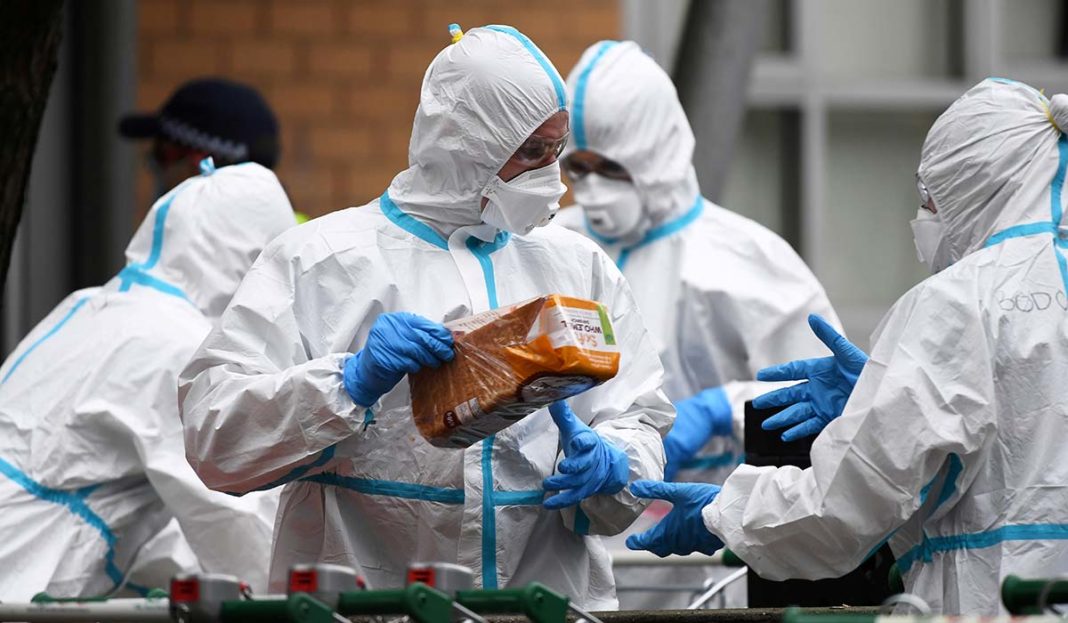

Amid growing concerns over the rise in the number of Covid-19 cases in the country, China has sent the military and thousands of healthcare workers into Shanghai to conduct corona tests for all of its 26 million residents.
According to reports, the People’s Liberation Army (PLA) has dispatched more than 2,000 medical personnel from across the army, navy and joint logistics support forces to Shanghai.
More than 10,000 healthcare workers from provinces including Jiangsu, Zhejiang and Beijing have also arrived in Shanghai by high-speed rail and aircraft to help curb the spike in the number of Covid-19 cases across the country.




The healthcare mobilisation in China is seen as its largest public health response since it tackled the initial Covid-19 outbreak in Wuhan. Shanghai, which began a two-stage lockdown on March 28 that has been expanded to confine practically all residents to their homes, reported 8,581 asymptomatic Ccovid-19 cases and 425 symptomatic cases for April 3. It also asked residents to self-test on Sunday.
Although the outbreak is small by global standards, the city has emerged as a test of China’s elimination strategy based on testing, tracing, and quarantining all positive cases and their close contacts.
The exercise in China’s most populous city takes place on the eve of when Shanghai initially said it planned to lift the city’s lockdown. The country has 12,400 institutions capable of processing tests from as many as 900 million people a day, a senior Chinese health official was reported as saying last month.
China primarily uses pool testing, a process in which up to 20 swab samples are mixed together for more rapid processing. The city has also converted multiple hospitals, gymnasiums, apartment blocks, and other venues into central quarantine sites, including the Shanghai New International Expo Center, which can hold 15,000 patients at full capacity.
The recent surge comes as the city is straining under the demands of the country’s ‘dynamic clearance’ strategy, with residents complaining of crowded and unsanitary central quarantine centers, as well as difficulties in securing food and essential medical help.
Some have begun to question the policies, asking why COVID-positive children are separated from their parents and why mild or asymptomatic infections – the majority of Shanghai’s cases – cannot isolate at home.
On Monday Shanghai official Wu Qianyu told a press conference that children could be accompanied by their parents if the parents were also infected, but separated if they were not, adding that policies were still being refined.
Last week, Vice-Premier Sun Chunlan, who was sent to Shanghai by the central government, urged the city to ‘make resolute and swift moves to curb the pandemic.
The eastern city of Suzhou said it had detected a version of the Omicron BA.1.1 subvariant that doesn’t match any others in the domestic database or the international variant tracking database GISAID, state television reported.
The state-backed Science and Technology Daily said it remains unclear whether the virus is a new sub-branch of Omicron and that the emergence of one or two new versions is normal given the spread of Omicron in China, citing an unidentified expert with a national database.


